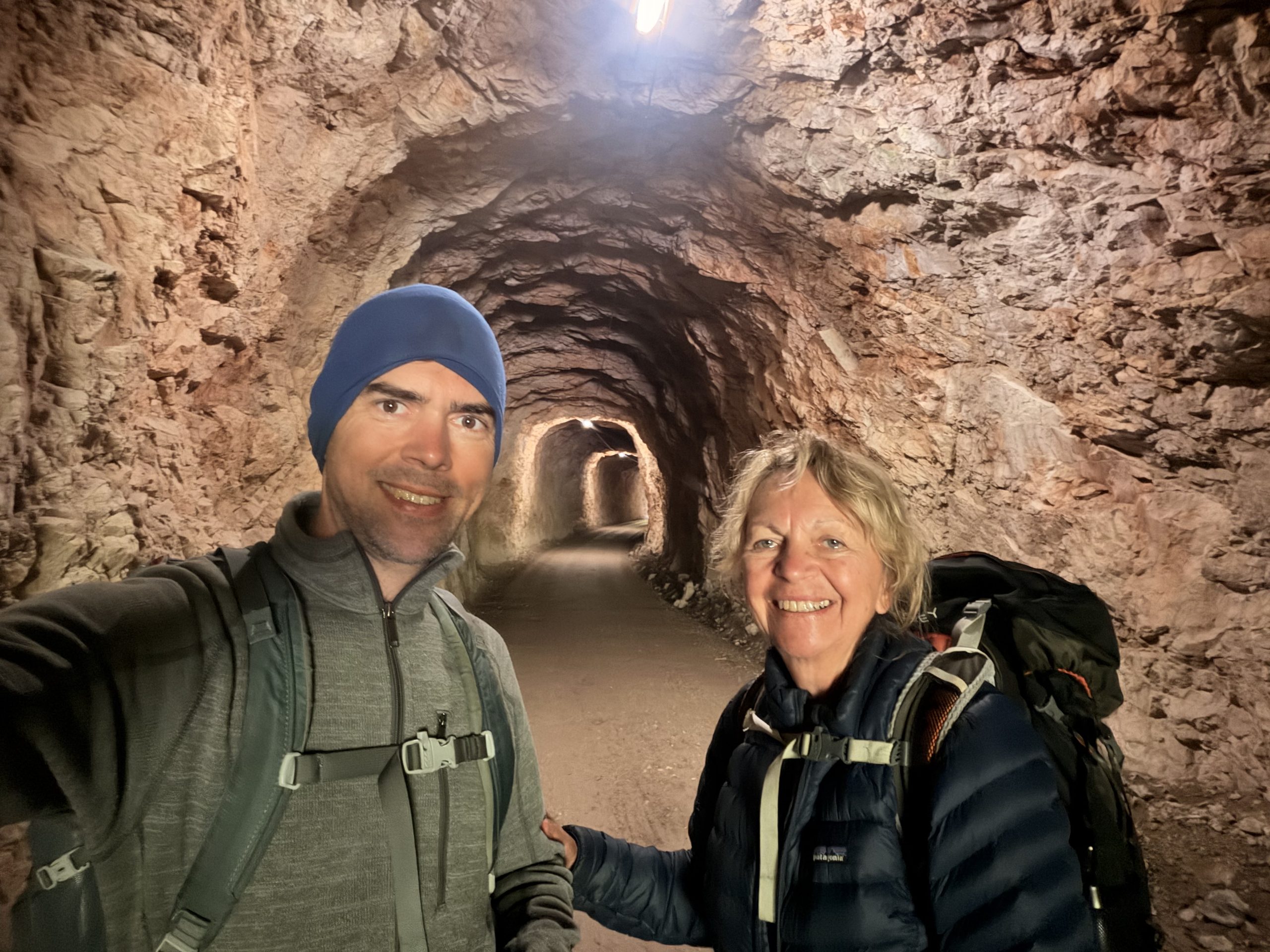

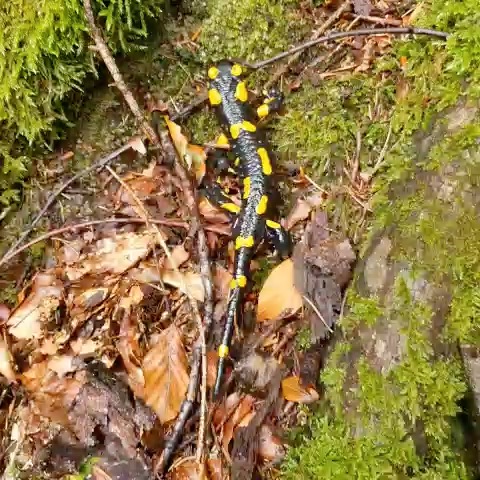
“Only for experienced hikers” reads a small sign at the beginning of our trail to the Ennserhütte, on the edge of the Kalkalpen National Park. The narrow, steep dirt path winds its way up the mountain. My son Robert has invited me on a three-day birthday hike, going from one mountain hut to another. Slowly and carefully, I make my way up the mountain. It is slippery. Every now and then, a fire salamander crosses our path. Moving forward effortlessly and serenely, it is almost indistinguishable from the earth beneath it, covered in yellow maple leaves. Calmly, it continues its way, undisturbed by our presence. We both love fire salamanders.
My son is a quantum physicist. Among other things, he researches the behavior of electrons in the universe. A world that is foreign to me. I occupy myself with philosophical questions: What is reality? How can it be experienced? Perhaps we are both searching for something similar, even though our paths towards it could hardly be more different.
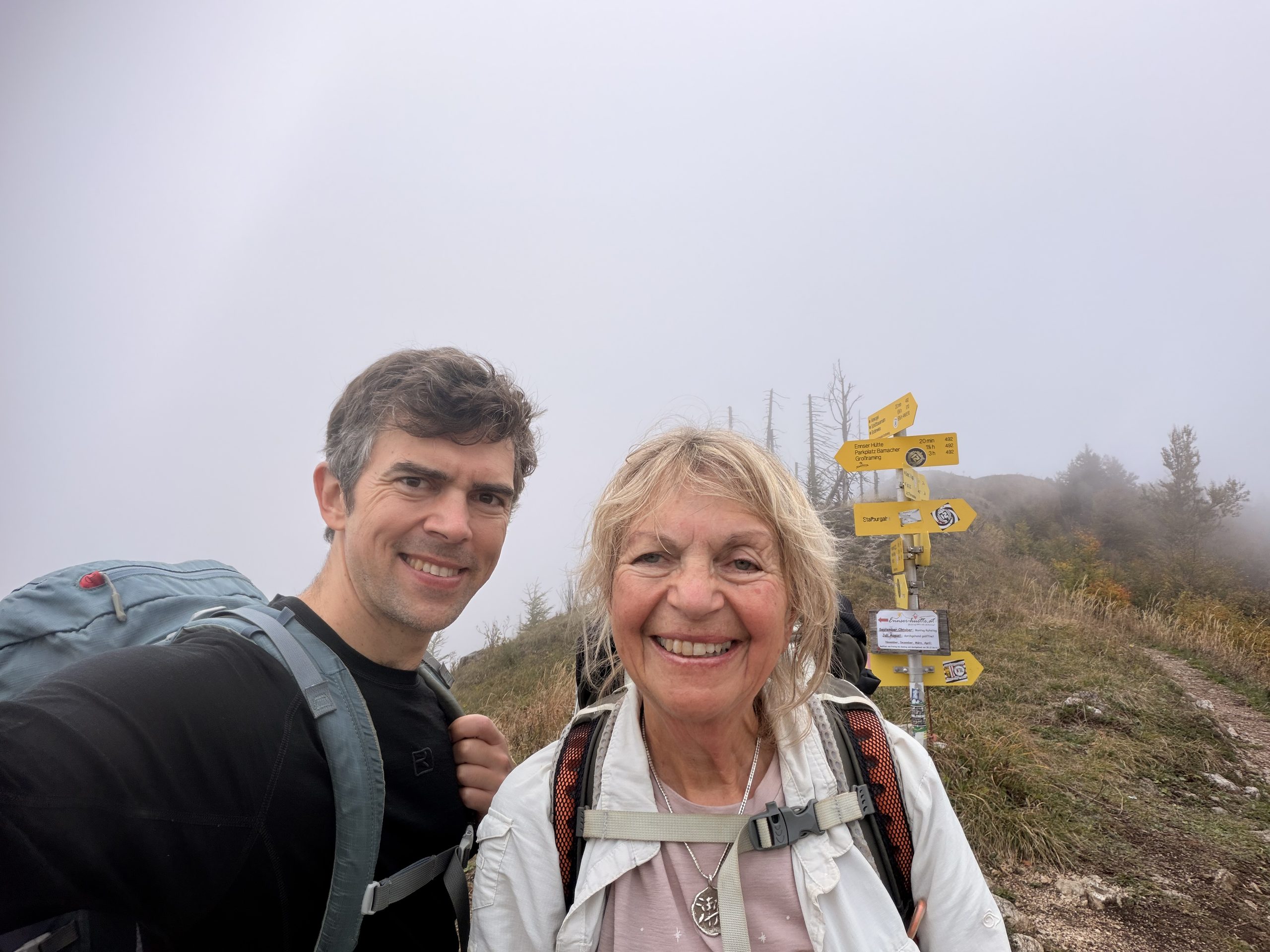
After hours of hiking and an ascent of 1,300 meters, we reach the Ennserhütte. We are the only guests. A cold wheat beer and a delicious Beuschel (a traditional Austrian dish made from beef heart and lungs) refresh us. Our hostess sits opposite us, beside the warm green tiled stove. She is filling little tea bags with herbal tea and carefully arranging them next to one another. We chat. Before going to bed, Robert and I step outside the hut to admire the starry sky. The entire sky sparkles with such splendor that we can only marvel. We don’t say a word! My head begins to vibrate, and I sense the extraordinary nature of this moment. This sky is always there, and yet we almost never see the mysterious depth and vastness that surrounds us. What a miracle! Bodhidharma’s words come to mind: “Nothing holy, just vast emptiness.”
For many months now, I have been carrying Bodhidharma’s koan on emptiness within me. I have been working with it in a Buddhist group. When I told Robert about it, he jokingly called it a “KAU-AN” (German). This is quite fitting, because I have been chewing on this koan, which cannot be understood by the intellect.
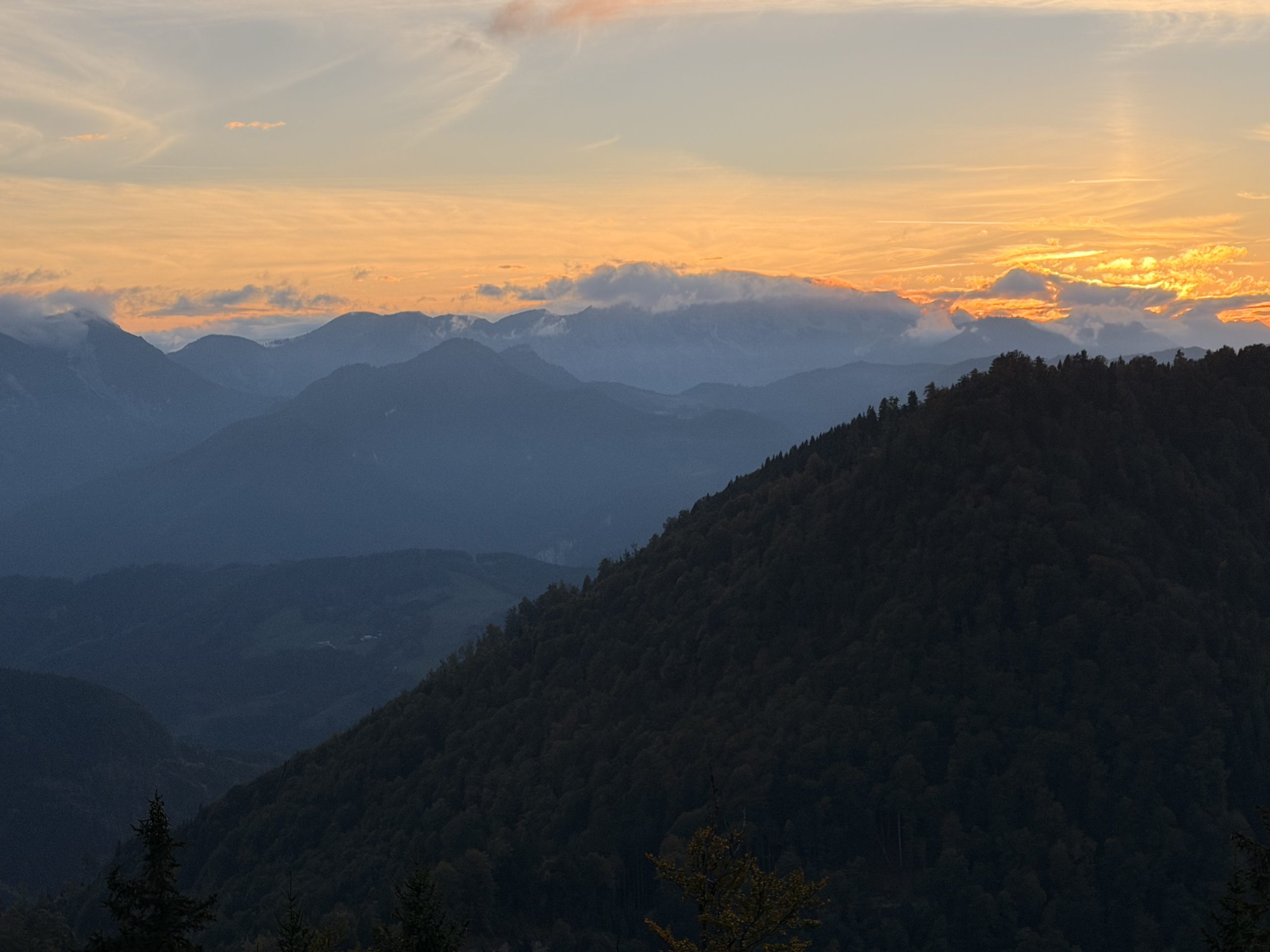
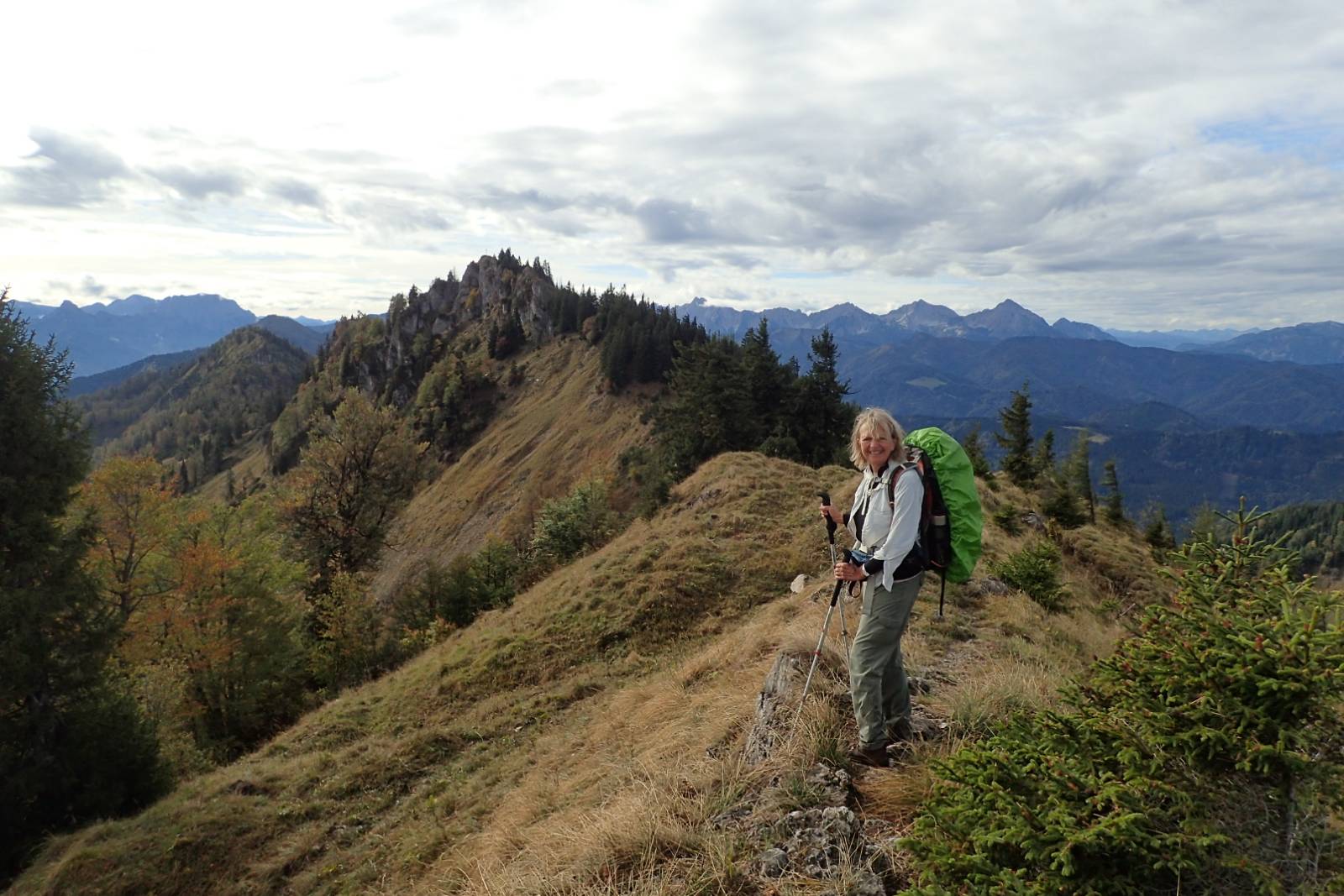
The following day’s hike takes us for hours along a mountain ridge to the Anlaufalm cabin. We are above the timber line. Only occasionally does a tree manage to grow at this altitude. The view is fantastic! Mountains, valleys and forests stretch as far as the horizon. At times, the ridge is barely half a meter wide. Steep, almost vertical grassy slopes plunge down on either side. Every step demands undivided attention. My two walking poles provide additional balance. Rilke’s poem accompanies me:
Exposed upon the mountains of the heart, see how small there,
See: the last village of words, and higher, yet how small, too, still a final homestead of feeling.
Do you recognize it?
Do I recognize it? I feel so free! Connected to the sky above me and the mountain ground beneath my feet, there is nothing left for me to hold on to. No church can be built on this ridge, no house, no hut. There is no place of shelter. One can only keep walking. Step by step, without clinging to anything.
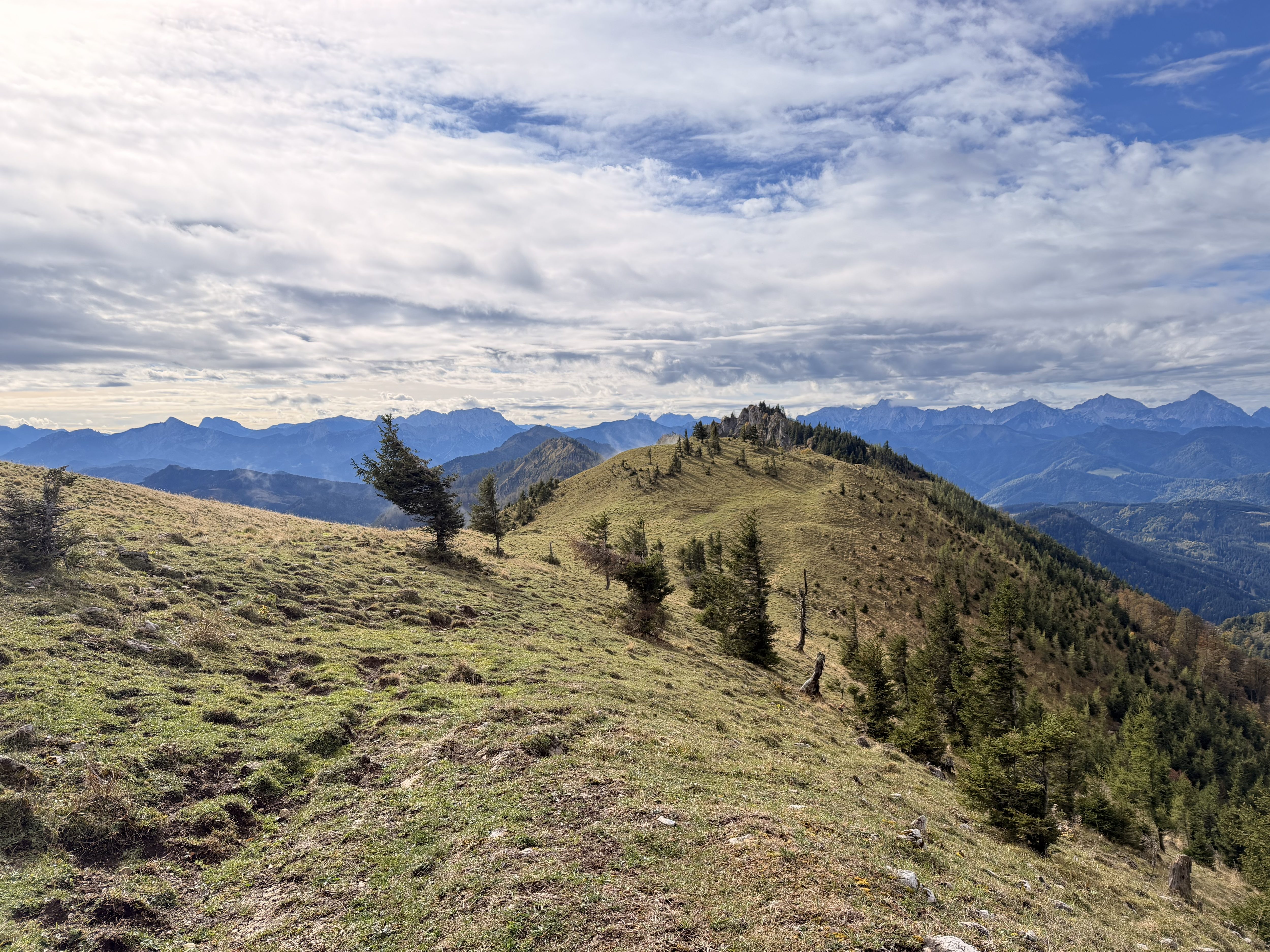
We are fortunate, too: we are spared storms, thunderstorms, ice, snow and torrential rain. I remember several hikes in the high mountains when lightning struck to my right and left. I was frightened. Yet in those very moments, I had to accept what was happening. There was nothing I could do except keep moving forward, step by step.
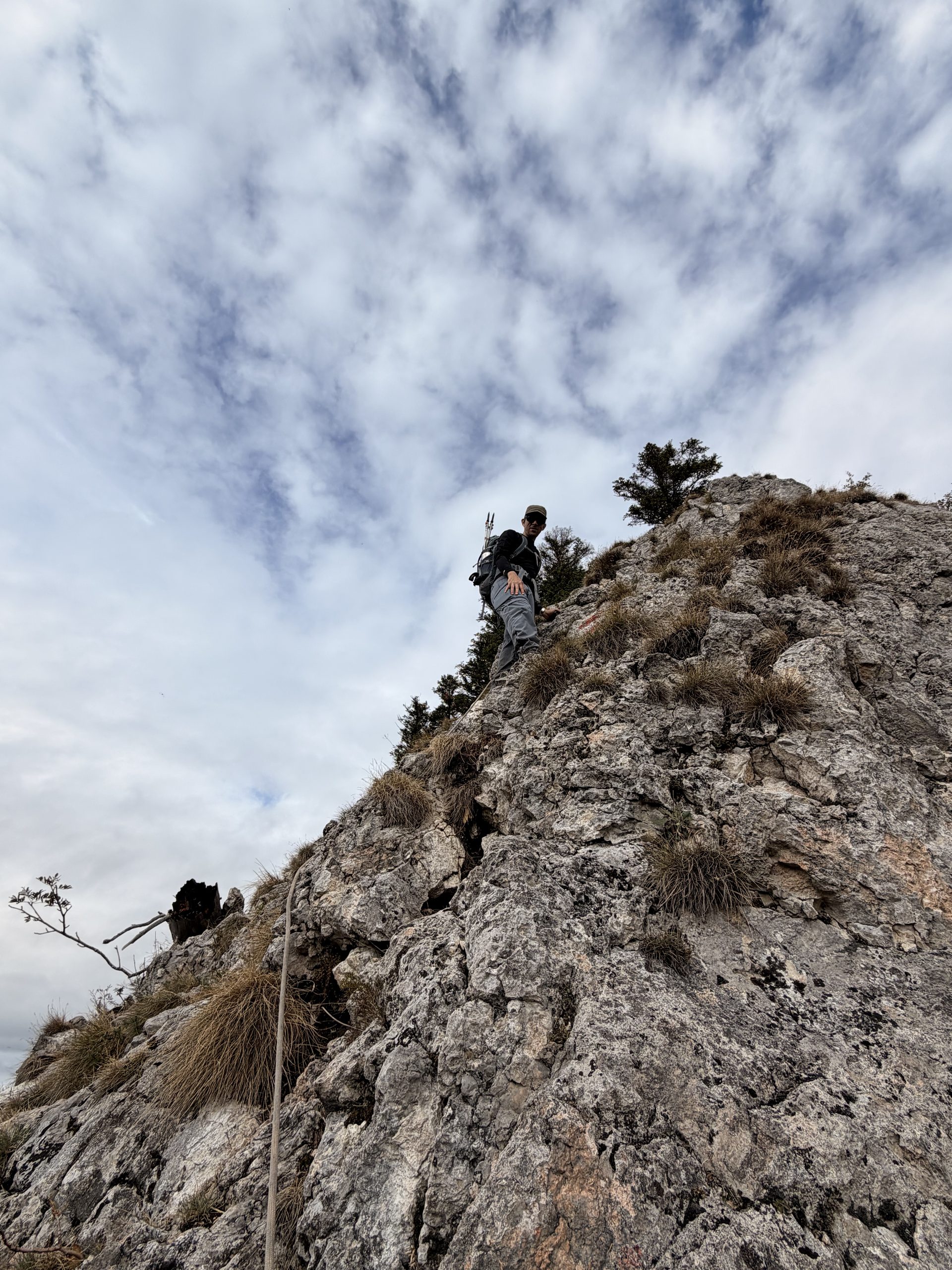
The ridge turns into a rocky ascent towards the summit cross. Along this trail there are many smaller peaks. The rain during the night has made the rocks extremely slippery. It is no longer my walking poles that provide additional support, but both my hands. The path down is secured by a plastic rope with knots along its length. I slip, fall and catch myself again.
Exposed upon the mountains of the heart.
Stony ground beneath the hands.
Here, surely, much is blossoming; from a mute plunge into the abyss, an unknowing herb springs forth, singing.
But the one who knows? Ah, the one who began to know and is now silent, exposed upon the mountains of the heart.
Around midday, we take a break on a fallen tree trunk and eat our muesli bars and chocolate. We talk about the previous night’s sky and a shared experience in the Rocky Mountains about twenty years ago. Back then, we sat beside a mountain lake at an altitude of around 4,000 meters, marveling at the sparkling starry sky, perfectly reflected in the still water. The sky, the lake and we ourselves were intimately and directly connected. Nothing stood between us any longer – no words, no concepts – just wonder. Is this the emptiness Bodhidharma speaks of?
There, in the healing consciousness,
many things move about, some sure-footed mountain animals, change and linger.
And the great, sheltered bird circles around the pure refusal of the peaks. —
But unsheltered, here upon the mountains of the heart. [1]
Is my life both things – the sure-footed mountain animal and the unsheltered bird circling around the summit of pure refusal? Did Rilke express the emptiness of which Bodhidharma speaks through his imagery? Can both be connected to quantum physics? Sitting with Robert at the source of knowledge, a conversation begins to unfold.
“What are the smallest particles in physics? Are these particles in any way dependent on one another? I would appreciate a simple explanation.”
“Electrons and quarks are the smallest elementary particles. They are not dependent on anything else.”
“In this sense, the ‘sameness’ of everything that exists could be explained,” I reply. “But how do the different manifestations of matter come about?”
“That can be explained by string theory,” Robert says. “The properties of a particle are related to its vibration. The particles are no longer particles, but strings. However, this theory has not yet been experimentally proven.”
I think of the Buddhist understanding of emptiness. It is explained in terms of “interconnectedness”: nothing exists independently of everything else. But can this be reconciled with what Robert tells me about elementary particles? I realize that I cannot connect Bodhidharma’s emptiness either with the independence of electrons or with string theory. It is like a cube that simply will not fit through a circular opening. Something doesn’t quite add up. We leave it there and continue our hike down to the Anlaufalm cabin. After all, the shared experience of being in the mountains is far more important.
A light rain begins to fall. The path winds down the forested slope in steep spirals. Once again, complete attentiveness is required. I am wearing my rain jacket, which I bought in Tokyo a few years ago. Back then, I hiked the Kumano Kodo pilgrimage trail with my Japanese friends. At the time, I was preoccupied with an acute bladder infection. Emptiness was nowhere in my mind; all I could think about was the next bush behind which I could disappear.
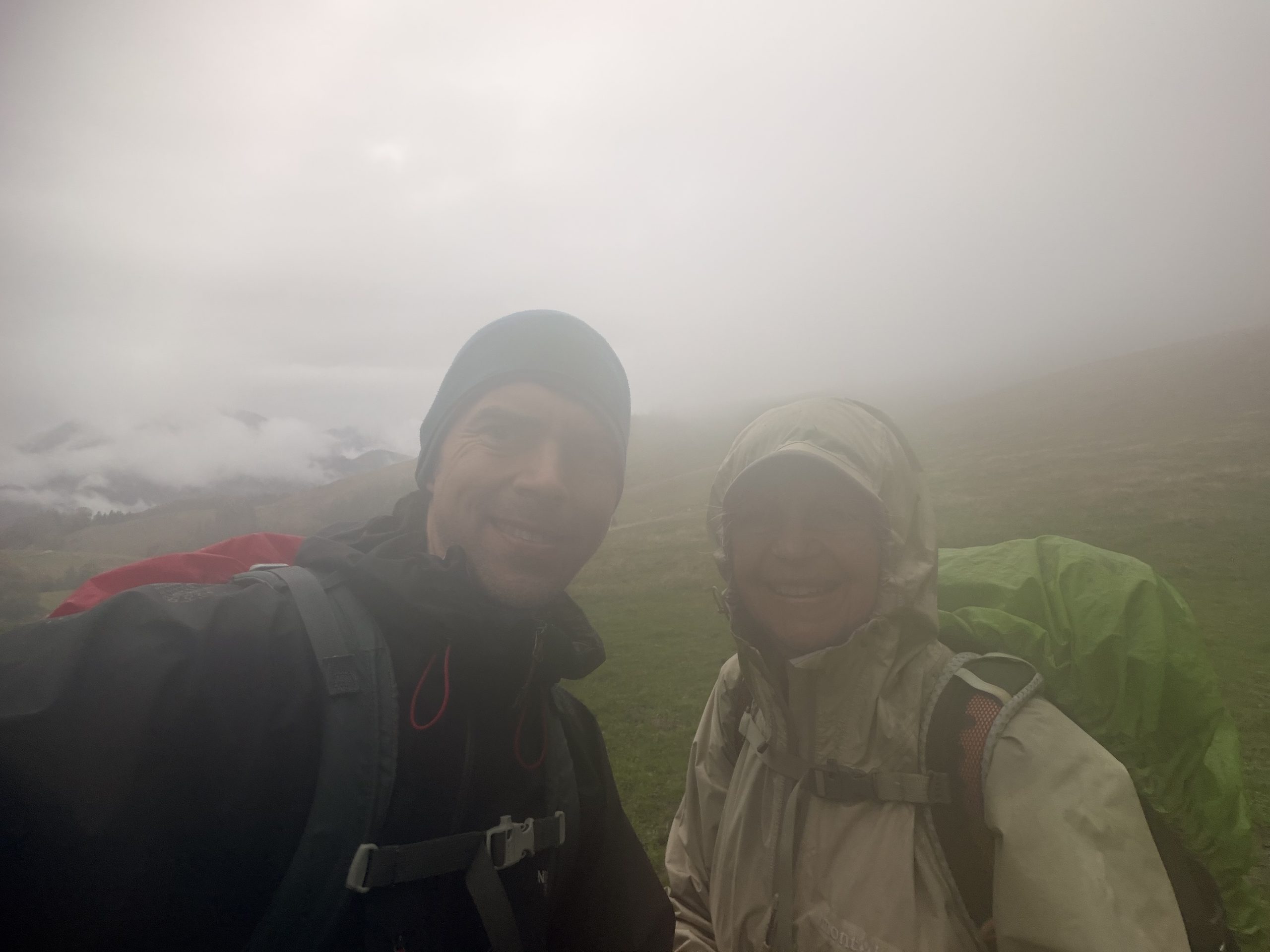
After approximately eight hours of hiking, we arrive at the Anlaufalm cabin. We sleep in a dormitory divided into individual sleeping cubicles. A group of hikers is already there. They are all resting until dinner.
My waterproof barefoot hiking shoes have failed to keep out the rain – my socks are completely soaked. Mud has also accumulated on my rain trousers. I spread my socks over one of the chairs to dry, along with my rain trousers and jacket.
The toilet is in a separate wooden building about 50 meters away. No problem says the hut keeper; a motion sensor will switch on the light. You must fetch your own beer from outside. Everything here is pared down to the essentials. This is not a cozy mountain inn, but a traditional alpine hut that also provides food and accommodation. Its main purpose is to serve the alpine herdsman, who looks after the animals grazing on the extensive mountain pasture. The animals, however, have already been brought down into the valley.
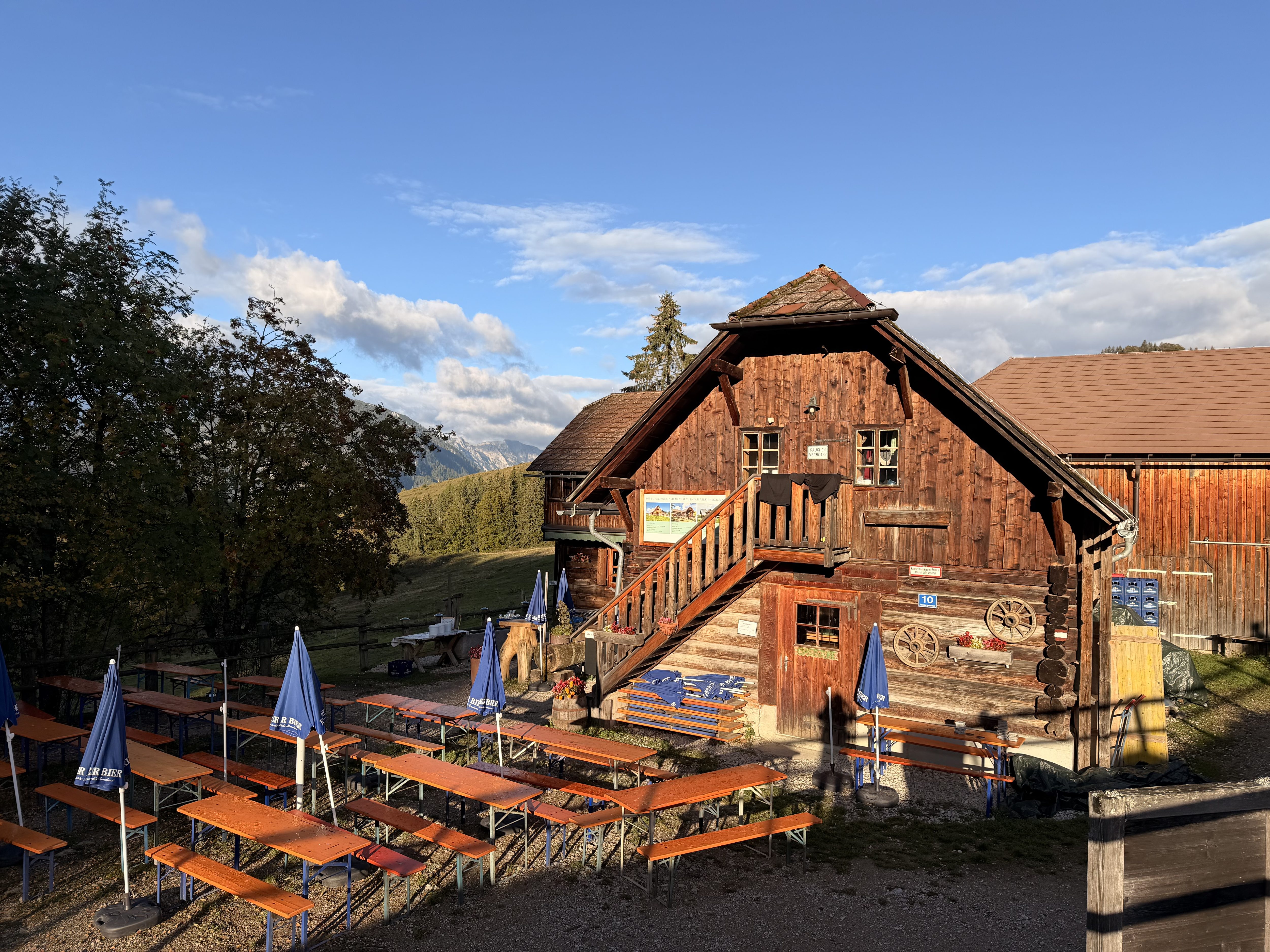
Before dinner, the hut keeper brings us fried porcini mushrooms and noodles as a welcome treat. The main course is good, too… Robert and I finish the evening with two small glasses of Zirbenschnaps, a traditional spirit made from Swiss stone pine. The hut is not as cozy as the Ennserhütte, but it has a charm of its own.
After a simple breakfast, we begin the long descent into the valley. For part of the way, we follow the Lynx Trail, named after the lynxes, that have been reintroduced to the area. Once again, this long walk gives rise to interesting conversations.
“Do you think,” I ask Robert, “that a stone has consciousness?”
“No,” he replies, answering my question with another question.
“What do you mean by consciousness?”
“I believe that everything is permeated by a universal consciousness.”
“That is a belief in an all-encompassing God,” Robert responds.
I realize that I have chosen the wrong words. What I mean is that the universe consists of an immediate presence that can be experienced through awareness. By awareness, I do not mean consciousness in the conventional sense. I mean something more like being intimately embedded in what is happening right now.
In this sense, all animals and plants possess awareness. Plants, for example, respond to light, gravity, water and much more. But what about a mountain?
I remember an experience in Phoenix, Arizona. I was hiking on my beloved Piestewa Peak, which has almost become a place of pilgrimage for me. Near the summit, beneath a small overhang, I had built a little rock shrine years ago. As I always did, I lit a small tea light and gave thanks to this wonderful mountain simply for being there.
At the same time, a thought arose: But you don’t have consciousness.
At that very moment, a rock face seemed to stare directly at me. I was shocked and astonished. It was no longer I who was looking at the mountain; the mountain was looking at me.
Was it my mind that had created this face, or was it the relationship with this mountain that had manifested itself in the rock face? Was it both? Do I need an explanation? Perhaps the experience itself is enough – just as it is when we gaze at the night sky?
This question, too, remains unanswered.
For hours, we continue down the mountain along narrow trails. The green, moss-covered roots and rocks speak of constant moisture. This is the ideal climate for mushrooms. Beneath the leafy forest floor, the bright red caps of fly agaric mushrooms occasionally emerge. The variety of tree fungi is astonishing. They grow in all shapes and colors on old, decaying tree trunks.
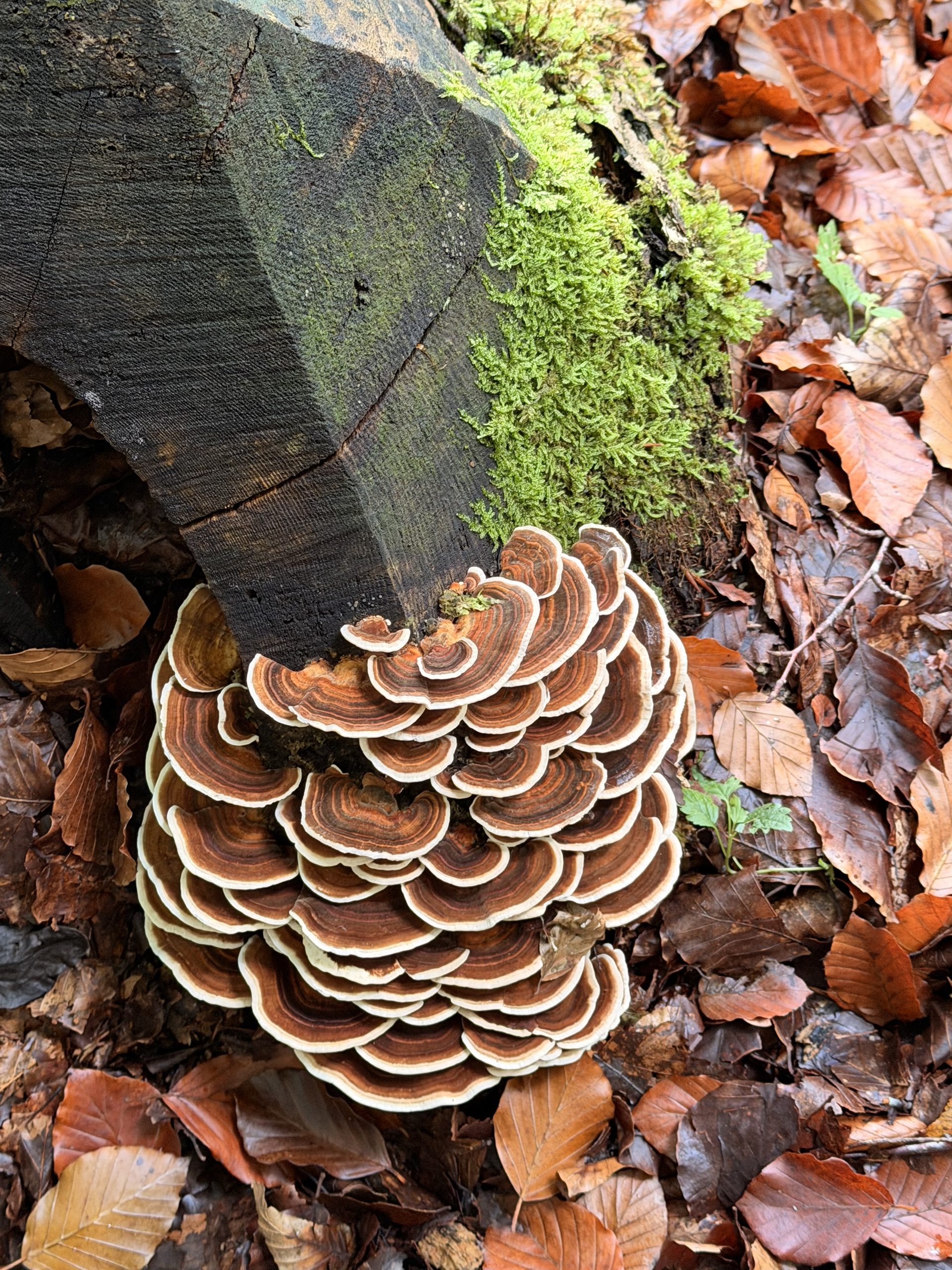
Once again, fire salamanders cross our path. This damp environment is an ideal habitat for them, too. Robert and I are captivated by this spectacle of nature.
We were unable to arrive at a shared answer about the nature of reality. But that was not necessary either. Nature was simply there. And we were right in the middle of it.